
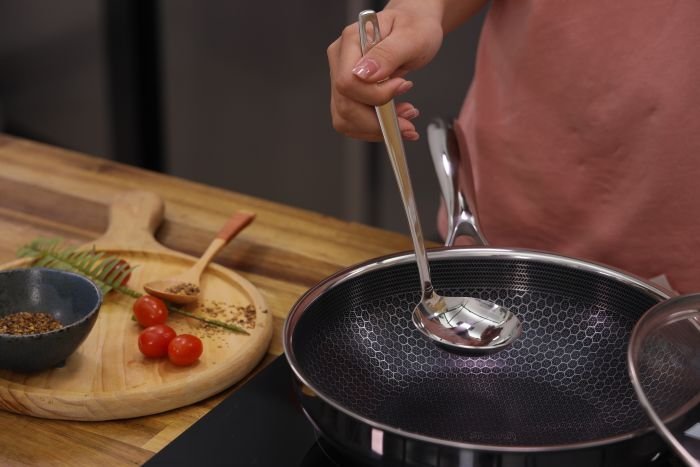
You know the drill. You buy a shiny nonstick pan, and it works great for about a year. Then the eggs start sticking, the coating gets scratched, and the pan ends up in the trash. Meanwhile, your stainless steel pan sits in the cabinet because everything sticks to it.
What if a stainless steel pan could also be non-stick? That’s the promise of the hybrid pan. It’s a hot topic in kitchens across the USA, and it’s easy to see why. But the hype can get loud, so let’s slow down and look at what hybrid cookware really is.
What Is a Hybrid Pan?
A hybrid pan combines stainless steel and nonstick in one cooking surface. The pan looks like steel, but it has a raised pattern, often hexagons or a grid. The tops of that pattern are steel. The little valleys between them hold a nonstick coating.
So when you cook, food touches both materials. The steel helps you get a good sear. The nonstick coating helps food release. That’s the whole idea behind hybrid cookware.
You can find hybrid pans in many forms: fry pans, saute pans, woks, and full sets. HexClad made the style famous, but other brands now sell their own versions.
Hybrid Pan Layers: What’s Inside?
Most hybrid pans are built like a sandwich. That’s why you’ll hear the term hybrid pan layers.
- Stainless steel outer layer. This makes the pan sturdy and works on induction.
- Aluminum core. Aluminum spreads heat fast and evenly, so you get fewer hot spots.
- Stainless steel inner layer. This is the cooking surface, with the pattern etched into it.
- Nonstick coating. This fills the valleys of the pattern.
This build is often called tri-ply. Some brands use more layers, and some use a thicker core. More layers aren’t always better, but a solid core does help with even heating.
Hybrid Pan Coating: What Is It Made Of?
The hybrid pan coating is usually a PTFE-based nonstick, the same family of materials used in many regular nonstick pans. Some brands now use ceramic-based coatings instead. Always check the product description to see which one you’re getting.
Here’s the clever part. In a regular nonstick pan, the coating covers the whole surface. In a hybrid, the steel ridges sit slightly higher than the coating. This means your spatula or food often touches the steel first, which helps protect the coating from wear.
Hybrid Pan vs Regular Nonstick Pan
Let’s put them side by side.
| Feature | Hybrid Pan | Regular Nonstick Pan |
|---|---|---|
| Surface | Steel ridges plus nonstick valleys | Fully coated surface |
| Searing | Good, close to stainless steel | Weak to average |
| Food release | Good, but little oil is needed | Excellent when new |
| Durability | Tougher surface | Scratches more easily |
| Metal utensils | Often allowed by brand (see below) | Usually not allowed |
| Price | Higher | Lower |
| Typical lifespan | Longer in most cases | Shorter, often a few years |
If you only cook eggs and pancakes, a cheap nonstick pan might be all you need. If you cook a wide mix of foods and want one pan to handle most of it, a hybrid makes more sense.
Hybrid Pan Pros and Cons
No pan is perfect. This is how things stand concerning hybrid pans.
Pros
- Sears meat better than most nonstick pans
- Needs less oil than stainless steel
- Heats evenly thanks to the aluminum core
- Tougher surface than a standard nonstick pan
- Works on all stovetops, including induction
- Often oven safe to high temperatures
Cons
- Costs more than most nonstick pans
- Not as slippery as a brand-new nonstick pan
- Can still stain or discolor over time
- Heavier than many nonstick pans
- The non-stick coating wears down eventually
The big takeaway: a hybrid is a middle path. It isn’t the best at any single job, but it’s very good at many.
Do Hybrid Pans Need Oil?
Yes, a little. Hybrid pans need less oil than stainless steel, but they aren’t fully oil-free like a perfect nonstick pan. A thin layer of oil or butter helps with browning, flavor, and easy release.
For eggs, use a small amount of fat and medium-low heat. For meat, preheat the pan, add oil, and let the food sit until it releases on its own.
Can You Use Metal Utensils on a Hybrid Pan?
Many hybrid brands say metal utensils are safe, because the steel ridges protect the coating.
Still, I’d go easy. Metal can leave marks on the steel, and hard scraping may wear the coating over time. Wood, silicone, or nylon tools are the safest choice if you want the pan to last. Always check your brand’s care guide, since rules differ.
Are Hybrid Pans Safe for High Heat?
Hybrid pans handle heat better than most nonstick pans, but “high heat” has limits. Nonstick coatings can break down if the pan gets too hot, so most brands suggest cooking on low to medium-high heat.
Here are a few simple rules:
- Don’t preheat an empty pan on high for a long time
- Use medium heat for most cooking
- Save very high heat for short searing, if your brand allows it
- Open a window or use your vent fan when searing
The steel and aluminum can take serious heat. The coating is the weaker link.
Are Hybrid Pans Non-Toxic?
This one deserves a careful answer. Many hybrid pans are made without PFOA, a chemical that was phased out of most US cookware. That’s a good sign. But “PFOA-free” doesn’t mean “chemical-free,” and PTFE-based coatings are still PTFE-based.
Used the right way, at normal cooking temperatures, nonstick cookware is generally considered safe for everyday use. Problems come mostly from overheating or from using a badly scratched pan. If you leave an empty pan on high heat for a long time, the coating can start to break down and release fumes. A badly scratched or peeling coating is another reason to replace a pan.
If you want to avoid PTFE altogether, look for a hybrid with a ceramic coating, and read what the brand says about its materials. Check your brand’s product page for details on materials and heat limits.
To stay safe, cook on low to medium heat, avoid preheating an empty pan on high, and use wood or silicone tools. Hand wash when you can, and retire the pan if the coating flakes.
Is a Hybrid Pan Oven Safe?
Usually yes. Many hybrid pans are oven safe up to around 400°F to 500°F. But the number depends on the brand, the handle material, and the lid.
| Part | Typical Oven Limit |
|---|---|
| Pan body | Often 400°F to 500°F |
| Glass lid | Often lower, around 400°F |
| Silicone or plastic handle | Check the manual |
Always check the label before you slide a pan into a hot oven. Handles and lids are often the limiting piece.
Can Hybrid Pans Be Used on Induction?
Yes, in most cases. Induction cooking needs a magnetic base, and most hybrid pans have a stainless steel exterior that works well. To be sure, hold a magnet to the bottom of the pan. If it sticks, it will work on induction.
Hybrid pans also work on gas, electric, and ceramic stovetops, which makes them a flexible choice.
How to Clean a Hybrid Pan
Cleaning is easy, as long as you’re gentle. Here’s a simple routine.
- Let the pan cool. Cold water on a hot pan can cause warping.
- Wash with warm water and mild dish soap. A soft sponge works best.
- Skip steel wool. It can damage the coating.
- Soak stuck food. Ten to fifteen minutes in warm soapy water loosens most messes.
- Dry it well. This keeps spots and stains away.
For stubborn stains or a rainbow-colored tint, a paste of baking soda and water helps. Some owners also use a gentle stainless steel cleaner on the steel ridges. Test it on a small area first and follow your brand’s advice.
Is a Hybrid Pan Dishwasher Safe?
Many brands say yes, their pans are dishwasher safe. But that doesn’t mean it’s the best idea. Strong dishwasher detergent and high heat can dull the finish and may shorten the life of the coating.
If you want your pan to last, hand wash it most of the time. Use the dishwasher only now and then, and only if your manual allows it.
Hybrid Pan Care: Simple Habits That Add Years
Good hybrid pan care is mostly common sense.
- Cook on low to medium heat most of the time
- Use a little oil or butter
- Choose wood, silicone, or nylon tools
- Don’t stack pans without a pan protector or cloth between them
- Let the pan cool before washing
- Avoid cooking sprays, which can leave a sticky film
- Store it where it won’t bang into other cookware
These small habits cost nothing, and they can double the useful life of your pan.
How Long Do Hybrid Pans Last?
It depends on how you treat the pan. Regular nonstick pans often last about 2 to 5 years. Hybrid pans can last longer, since the steel ridges protect the coating, and some brands offer long warranties. A well-cared-for hybrid may stay in good shape for many years.
But nothing lasts forever. If the coating is peeling, flaking, or badly worn, it’s time to replace the pan. A warranty can give you peace of mind, but read the fine print on what it covers.
What to Look For in a Hybrid Pan
Not all hybrid cookware is built the same. Before you buy, check these points.
| What to Check | Why It Matters |
|---|---|
| Layers and core | A solid aluminum core means even heat |
| Coating type | PTFE-based or ceramic, depending on your comfort level |
| Oven safe rating | Look for a clear temperature limit |
| Induction ready | Make sure the base is magnetic |
| Weight and handle | A comfortable grip makes daily use easier |
| Warranty | A longer warranty shows brand confidence |
| Price | Higher price doesn’t always mean better quality |
| Brand honesty | Clear facts about materials and care are a good sign |
Start with one good fry pan before buying a full set. It’s the pan you’ll use most, and it’s the easiest way to find out if you like hybrid cooking.
Who Should Buy a Hybrid Pan?
A hybrid pan is a great fit if you:
- Want one pan that sears, saute, and fries
- Cook on induction
- Are tired of replacing nonstick pans
- Like the look and feel of stainless steel
It might not be the best choice if you:
- Mostly cook delicate eggs and want the slickest surface
- Are shopping on a tight budget
- Want to avoid nonstick materials completely
Popular Brands
HexClad is the best-known name, and it’s the brand that made the style popular. Its pans have the steel-ridge and nonstick-valley pattern, and Gordon Ramsay has helped promote it.
Anolon X is another well-known option. It uses a hybrid design with a steel mesh pattern and a nonstick coating, and it usually costs less than HexClad.
Related product: Anolon X Hybrid Nonstick Frying Pan (sponsored link to Amazon)
Final Thoughts: Is a Hybrid Pan Right for Your Kitchen?
A hybrid pan won’t change your cooking overnight. But it can make everyday meals easier, with better browning, less sticking, and a pan that holds up longer than a basic nonstick one.
The key is realistic expectations. Use medium heat, add a little oil, wash it by hand, and it can serve you well for years.
So what about you? Have you tried hybrid cookware in your kitchen, or are you still thinking about it? Share your experience in the comments, and tell us which pan you’d like us to review next. And if this guide helped, pass it along to a friend who’s tired of sticky eggs.

About the Author
Hi, I’m the creator of Two Tiny Spoons. I am a retired researcher who has spent over 10 years obsessing over cookware materials, food safety, and manufacturing standards. I don’t care about fancy recipes—I care about the science behind the tools we use. I independently vet every product to ensure it is non-toxic, durable, and truly worth your money.