
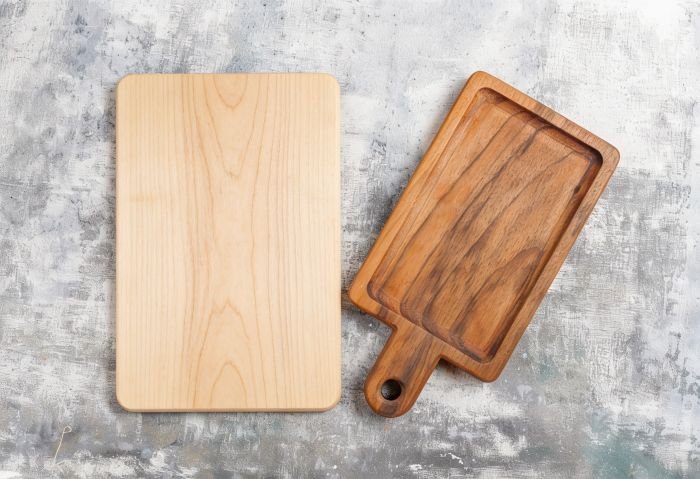
Stand in front of a cutting board display at any kitchen store, and you’ll probably freeze up for a second. There’s the pale, honey-colored maple. Right next to it is the deep, chocolatey walnut. Both look gorgeous. Both promise to be “the best cutting board you’ll ever buy.” And both cost more than you probably want to spend.
So, which one should you pick?
The Short Answer (For Those in a Hurry)
Both are excellent choices. But they’re excellent in different ways.
- Maple is the workhorse. It’s harder, more affordable, and it’s what most professional kitchens reach for.
- Walnut is the showpiece. It’s a bit softer on your knives, stunning to look at, and slightly pricier.
If you want the deep dive (the details matter here), keep reading.
Walnut vs Maple Cutting Board: The Quick Comparison Table
| Feature | Walnut | Maple |
|---|---|---|
| Hardness (Janka scale) | ~1,010 lbf | ~1,450 lbf |
| Knife-friendliness | Gentler on blades | Slightly harder on blades |
| Durability | Very good, but softer surface | Excellent, holds up to heavy use |
| Color | Rich dark brown/chocolate | Light cream/blonde |
| Porosity | Low (naturally tight grain) | Low (tight, closed grain) |
| Maintenance | Needs regular oiling | Needs regular oiling |
| Price | Higher | Moderate |
| Best for | Aesthetics, gentle knife care | Heavy daily use, budget-conscious cooks |
Keep this table in the back of your mind — we’re going to unpack every single row.
First Things First: Is Maple Harder Than Walnut?
Yes, maple is harder than walnut. On the Janka hardness scale (which measures how much force it takes to dent a piece of wood), maple clocks in around 1,450, while walnut sits closer to 1,010.
Does that number actually matter in your kitchen? Kind of. Here’s the thing about wood hardness and cutting boards — it’s a bit of a trade-off, not a simple “harder is better” situation. A harder wood resists dents and gouges better, sure. But it also fights back a little more against your knife edge every time you slice.
Think of it like running on pavement versus running on a track. Pavement (maple) is tougher and lasts longer under pressure. The track (walnut) is easier on your joints — or in this case, your knife’s edge.
Walnut vs Maple Cutting Board Durability: Who Wins Long-Term?
This is where people get genuinely torn, so let’s break it down properly.
Maple’s durability case:
- Its hardness means it shrugs off deep knife grooves for longer.
- It handles heavy chopping (think butchering, dense veggies, bone-in cuts) without showing wear as fast.
- It’s the wood you’ll find in most commercial kitchens, and there’s a reason for that — it survives abuse.
Walnut’s durability case:
- It’s still a hardwood, not a soft one — it’s not going to fall apart on you.
- Its tight grain structure resists warping and cracking really well.
- It shows surface wear a touch faster, but its dark tone hides minor marks.
So if we’re talking pure structural toughness, maple edges out walnut for durability, especially if your board sees daily heavy-duty action. But walnut isn’t fragile by any stretch — it’s just built for a slightly gentler rhythm.
Which Wood Is Gentler on Your Knife Blades?
Here’s a question asked constantly, and it’s one of the most practical ones on this whole list: walnut vs maple cutting board knife friendliness — which wins?
Walnut wins this time.
Because walnut is softer, it lets your knife’s edge sink in just slightly with each cut instead of bouncing off a rock-hard surface. Over months and years, that means less time at the sharpening stone. If you’re dreaming about a nice Japanese chef’s knife, this matters more than you’d think.
Maple isn’t harsh on knives by any means — plenty of professional chefs use maple boards daily, and their knives are just fine. But if you’re the type obsessed with keeping your blade razor sharp for as long as possible, walnut makes it possible.
Walnut’s softer surface is kinder to your blade, so if anything, maple will require slightly more frequent honing over time.
Maintenance: Which Board Is Easier to Live With?
Let’s be real — nobody wants a needy cutting board. You want something you can wipe down, maybe oil once in a while, and get on with your life.
Good news: maintenance is nearly identical between the two.
Both walnut and maple need:
- Regular mineral oil applications (once a month for average use, more if it sees a lot of water)
- Occasional beeswax or board cream conditioning to keep the wood from drying out
- Hand washing only — never the dishwasher (heat and moisture will warp and crack either wood)
- Quick drying after washing, in an upright position to allow air to circulate
So does one need less oiling than the other? Not really — it comes down more to your climate and how often you wash the board than the species of wood. If you live somewhere dry, you’ll be oiling either board more frequently, regardless of species.
One small nuance: because maple is lighter in color, it can show water rings and dry spots more obviously than the deep-toned walnut. So maple might nag at you visually to oil it sooner, even if it doesn’t strictly need it more often.
Which Cutting Board Stains Less: Walnut or Maple?
Walnut stains less — hands down.
Think about it logically: walnut is already a deep brown. A little turmeric splash, a beet juice drip, a tomato sauce smear? It practically disappears into the wood’s natural tone.
Maple, on the other hand, is pale and creamy — which means every stain shows up like a spotlight. Cut a beet on a maple board even once and you’ll know exactly what I mean. That pinkish-purple tint can linger for a while, even after scrubbing.
If you cook with a lot of turmeric, berries, beets, or tomato-based sauces, walnut will hide those sins a lot better.
Which Cutting Board Shows Fewer Knife Marks?
Similar logic applies here. Walnut wins again, mostly because of color, not because it’s magically immune to marks.
Every cutting board — walnut, maple, or otherwise — will develop knife marks eventually. It’s physics. But on maple’s light surface, those marks show up as visible pale scratches. On walnut’s dark surface, they blend in far more subtly.
So while maple might actually resist deep gouging slightly better (thanks to its hardness), the marks it does get are more noticeable. Walnut, being a bit softer, might pick up marks a touch easier — but you’ll barely see them.
Food Safety: Is Walnut or Maple Cutting Board Safe to Use?
Good news: both walnut and maple cutting boards are completely food safe.
Wood is naturally antimicrobial in a way plastic isn’t. Studies on wooden cutting boards have shown that bacteria actually die off faster on wood surfaces compared to plastic, largely because wood draws moisture (and the bacteria in it) down into the fibers, away from the surface, where it dries out and dies.
A few caveats that apply to any wood board, walnut or maple:
- One allergy note: if anyone in your household has a tree nut allergy, walnut wood itself is not going to transfer allergens through food contact — the wood isn’t the nut. But if you’re extra cautious, maple is the “safer” psychological choice for nut-allergy households, even though walnut wood boards don’t pose an actual nut-allergy risk.
- Always wash thoroughly after cutting raw meat.
- Never let either board soak in water.
- Sanitize with a vinegar or diluted bleach solution occasionally.
Which Cutting Board Is Better for Raw Meat?
Both handle raw meat just fine, but maple has a slight edge for raw meat prep, mainly because of its hardness and tighter surface — it resists the kind of deep grooves where bacteria could theoretically hide.
That said, a lot of serious home cooks and chefs keep a dedicated board for raw meat regardless of species — maple, walnut, or otherwise — just to avoid cross-contamination. That habit matters way more than which wood you choose.
Which Cutting Board Is Less Porous?
Both walnut and maple are closed-grain hardwoods, meaning their pores are naturally tight and small. This is actually why both are recommended by food safety experts over open-grain woods like oak (which has larger, more open pores that can trap bacteria and moisture).
If we’re splitting hairs, maple’s tighter cellular structure gives it a very slight edge in the “less porous” category, but honestly, it’s close enough that it shouldn’t be a deciding factor for you.
The Price Question: Which Cutting Board Is More Expensive?
Walnut typically costs more than maple.
Why? A few reasons:
- Walnut trees grow slower and are less abundant commercially than maple.
- Walnut has that striking, rich color that’s in high demand for furniture and high-end kitchenware — driving prices up.
- Maple is more widely farmed in the U.S., keeping supply steady and prices friendlier.
If you’re on a budget but still want a quality hardwood board, maple gives you more bang for your buck. If you’ve got a little extra to spend and want your board to double as a showpiece, walnut is worth the splurge.
Looks Matter: Is Walnut Better for Aesthetics Than Maple?
I’ll be honest, this one is subjective — but let’s talk about it anyway because it genuinely factors into people’s decisions.
Walnut brings:
- Deep, rich chocolate-brown tones
- A luxurious, almost furniture-grade look
- A board that photographs beautifully
Maple brings:
- A bright, clean, farmhouse-kitchen feel
- A classic, timeless look that never goes out of style
- A neutral canvas that matches literally any kitchen decor
If you’re using your board as a serving piece for cheese and charcuterie (not just prep), walnut tends to steal the show. If you want something that blends seamlessly into a bright, airy kitchen, maple might feel more “at home.”
Everyday Kitchen Use vs Professional Kitchens
Here’s a distinction worth making because it changes the answer depending on who’s asking.
For everyday home cooks: Either board works beautifully. It really comes down to personal preference on looks, budget, and how gentle you want to be on your knives.
For professional chefs: Maple tends to dominate professional kitchens, and it’s not just tradition. Restaurants need boards that can survive:
- Constant, heavy use for 10+ hours a day
- Repeated sanitizing
- Rough handling by rotating staff
Maple’s extra hardness makes it the more practical, cost-effective choice at scale. That said, plenty of chefs keep a nicer walnut board at home for weekend cooking projects, where the pace is slower and the aesthetics matter more.
End-Grain Walnut vs End-Grain Maple: Does It Change Anything?
Quick refresher: end-grain boards are cut so the wood fibers stand vertically, like a bundle of straws, rather than lying flat (edge-grain or face-grain). This construction is prized because the knife blade slides between the fibers rather than across them, which is significantly gentler on both your knife and the board itself.
- End-grain walnut takes walnut’s natural knife-friendliness and amplifies it — this combo is about as gentle on blades as wood cutting boards get.
- End-grain maple takes maple’s durability and combines it with the self-healing properties of end-grain construction, creating one of the most resilient, long-lasting cutting surfaces you can buy.
Honestly, if you’re going to invest in either wood, end-grain construction is worth the extra cost regardless of species. It’s the difference between a board that lasts 5 years and one that lasts 25.
Does Maple Warp More Than Walnut?
Not inherently, no. Warping has more to do with board construction and care than the species of wood. Both walnut and maple can warp if:
- They’re not properly dried before storage
- They get exposed to excess moisture (soaking, dishwashers, sitting in a wet sink)
- They dry out too aggressively (direct sunlight, near a heat vent)
- They’re a single flat slab rather than edge-grain or end-grain construction
A well-made board — from a reputable maker, properly kiln-dried, and constructed as edge-grain or end-grain — will resist warping beautifully whether it’s walnut or maple. The wood species matters far less here than the craftsmanship.
So… Which Wood Is Best for a Cutting Board Overall?
Alright, decision time.
Choose maple if:
- You want the most durable, hardest-wearing option
- You’re prepping raw meat frequently
- You want to save some money without sacrificing quality
- You’re cooking in high-volume, heavy-use conditions
Choose walnut if:
- You want to protect your knife edges as much as possible
- You care about how your board looks on the counter
- You cook with a lot of stain-prone ingredients like turmeric or beets
- You’re willing to spend a bit more for a striking, furniture-quality piece
A lot of serious home cooks end up owning both — a hardworking maple board for daily chopping and a gorgeous walnut board for serving, entertaining, and the occasional Sunday cooking project where you actually have time to enjoy the process.
Final Thoughts
At the end of the day, this isn’t a “one is right and one is wrong” situation. It’s a “what do you actually need from your kitchen” situation. Maple is the reliable friend who shows up every single day and never complains. Walnut is the elegant friend who makes every dinner party a little more special.
Whichever you choose, treat it right — oil it regularly, hand wash it, and let it dry standing up — and either wood will serve you for decades to come.

About the Author
Hi, I’m the creator of Two Tiny Spoons. I am a retired researcher who has spent over 10 years obsessing over cookware materials, food safety, and manufacturing standards. I don’t care about fancy recipes—I care about the science behind the tools we use. I independently vet every product to ensure it is non-toxic, durable, and truly worth your money.