Stand in the cookware aisle for five minutes, and you’ll start to wonder if a skillet, a wok, and a frying pan are really three different things — or just three names for the same round piece of metal. It’s a fair question. The shapes look similar. The prices overlap. And every cook you ask seems to have a slightly different opinion.
Here’s the short answer: they’re related, but they’re not interchangeable. Each one is shaped and built for a different kind of cooking. Once you understand why, picking the right pan for the right job gets a lot easier — and you’ll find it easier to decide which one is the best one to buy.
This guide explains the pan, wok, and skillet debate in a simple way, including comparisons, tables, and answers to the questions people most often ask.
The Quick Description
- Frying pan — flat bottom, low sloped sides, made for everyday frying, sautéing, and eggs.
- Skillet — basically a heavier-duty frying pan, often cast iron, built for high heat and oven use.
- Wok — deep, curved bowl shape, made for fast, high-heat stir-frying and tossing food. Your specialist for Asian-style cooking.
What Is the Difference Between a Skillet, Wok, and Frying Pan?
The differences come down to three things: shape, material, and purpose.
A frying pan has a flat bottom and shallow, gently sloped sides. It’s light, heats quickly, and is designed so you can slide a spatula under an egg or flip a pancake without a fight.
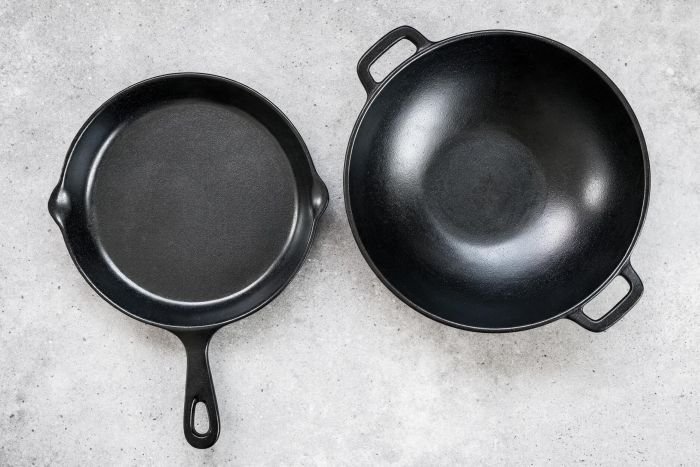
A skillet looks similar but is usually thicker and heavier, often made of cast iron. That extra weight means it holds heat longer and can go from stovetop to oven without issue. Many people use “skillet” and “frying pan” as interchangeable words, but there’s a real construction difference once you compare the two side by side.
A wok is a completely different shape. It has a deep, bowl-like body with high, curved sides. The bottom is either completely round and curved or has a small, flat circular disc at the base. That shape lets heat travel up the sides, so you can toss food around without it flying out of the pan.
Comparison table: Skillet vs Wok vs Frying Pan
| Feature | Skillet | Wok | Frying pan |
| Shape | Flat bottom, relatively shallow sides | Curved bowl shape, high sides | Flat bottom, shallow to medium sides |
| Best for heat contact | Excellent for direct contact and browning | Lower direct contact, designed for movement and tossing | Strong direct contact, good for general frying |
| Heat retention | High, especially with cast iron or carbon steel | Moderate to high, but depends heavily on stove power and material | Moderate, varies by material and thickness |
| Heat distribution | Even, especially on flat burners | Hot center, cooler sides for staged cooking | Even across the base, ideal for standard frying tasks |
| Typical materials | Cast iron, carbon steel, stainless steel, nonstick | Carbon steel, cast iron, stainless steel, nonstick | Stainless steel, nonstick, aluminum, cast iron |
| Capacity | Medium | High | Medium |
| Tossing/stirring ease | Moderate | Excellent | Moderate |
| Best cooking methods | Searing, frying, sautéing, shallow frying, pan sauces | Stir-frying, tossing, steaming, deep-frying, quick noodle/rice cooking | Frying, sautéing, eggs, pancakes, cutlets, general stovetop cooking |
| Ideal dishes | Steak, chicken thighs, eggs, potatoes, burgers, fish fillets | Fried rice, chow mein, stir-fried vegetables, noodles, small meat strips | Eggs, omelets, pancakes, schnitzel, sautéed vegetables, simple pan-fried dishes |
| Stove suitability | Excellent on gas, electric, induction depending on base | Best on high-heat gas; flat-bottom versions work better on home cooktops | Works well on most cooktops |
| Learning curve | Easy | Moderate, especially for high-heat wok cooking | Easy |
Is a Skillet Better than a Frying Pan?
A frying pan is typically lighter and made of thinner metal, so it heats up fast — great for quick jobs like scrambling eggs or toasting a sandwich. A skillet is heavier, holds heat more evenly, and can handle higher temperatures for longer stretches, which is why it’s the go-to for searing a steak or making cornbread that finishes in the oven.
Think of it this way: every skillet can do what a frying pan does, but not every frying pan can do what a skillet does.
Is a Wok Better Than a Frying Pan?
“Better” depends on what you’re cooking. A wok isn’t an upgrade to a frying pan — it’s a different tool for a different job.
- If you’re cooking stir-fries, fried rice, or noodles, a wok wins easily. The curved shape lets you toss ingredients so they cook fast and evenly without steaming in their own liquid.
- If you’re making eggs, grilled cheese, or pancakes, a flat frying pan wins because the shape matches the food.
So instead of asking which is better overall, it helps to ask which one matches what’s on your menu tonight.
Which Tool Is Better for Stir-Frying: Wok or Skillet?
We have partially answered this question. For true stir-frying, the wok is the better tool, hands down. The tall, sloped sides let you keep ingredients moving constantly over very high heat, which is the whole point of stir-frying — quick cooking that keeps vegetables crisp and meat tender.
A skillet can do a decent job in a pinch, especially a wide, flat-bottomed one. But because the sides are lower, food is more likely to spill over the edge when you toss it, and the surface area heats less evenly than a wok’s curved shape.
Can You Use a Wok Instead of a Frying Pan?
Yes, in most cases. A flat-bottomed wok works fine for many frying-pan tasks like sautéing vegetables, cooking eggs, or browning meat. The bigger surface area even makes it useful for cooking larger batches at once.
Where it struggles is with foods that need flat, steady contact to get a proper crust, such as whole steaks, where a flat frying pan surface just makes life easier.
Can You Use a Frying Pan Instead of a Wok?
You can, and plenty of home cooks do this every day. A wide, heavy frying pan or skillet can handle a stir-fry reasonably well, especially in smaller batches. The main tradeoff is that you’ll get less of that slightly smoky, charred flavor that comes from food briefly touching the very hot curved sides of a wok.
If you’re cooking for one or two people and don’t want to buy another pan, a frying pan is a perfectly reasonable stand-in.
Which Pan Is Best for Searing Meat?
A cast iron skillet is the classic choice for searing meat, and for good reason. It holds very high heat and keeps that heat steady even after you add a cold piece of meat to the pan, which is exactly what you need for a deep, brown crust.
A heavy stainless steel frying pan can also do a great job. Woks are less ideal here since the curved bottom means less flat surface contact with the meat.
Which Pan Is Best for Eggs?
A nonstick frying pan is the easiest choice for eggs. The flat surface, low sides, and slick coating make flipping and sliding eggs out simple, with less sticking and less mess.
A well-seasoned skillet can also cook great eggs, though it takes a bit more technique to avoid sticking compared to nonstick.
Which Pan Is Best for Fried Rice?
The wok is the traditional and most practical choice for fried rice. Its shape lets you toss the rice constantly, so it cooks fast, dries out slightly for that classic texture, and doesn’t turn mushy. The high sides also make tossing rice around far less messy than trying to do it in a flat pan.
Which Pan Is Best for Noodles?
Again, the wok takes the win here. Stir-fried noodle dishes need constant movement so noodles don’t clump or stick to the pan, and the wok’s curved shape and high heat retention make that easy. A large skillet can work for simpler noodle dishes, but it won’t toss as cleanly.
Dish-by-dish guide
- Steak: skillet, because the flat base gives the best surface contact and browning.
- Fried rice: wok, because it supports fast tossing and high-heat cooking.
- Stir-fried vegetables: wok for the most authentic result, or a skillet/stir-fry pan if your stove is weaker.
- Eggs: frying pan or skillet, because both give even contact and easy flipping.
- Pancakes: frying pan or skillet, since the flat base helps with even browning.
- Noodles: wok, especially for quick tossing and sauce distribution.
- Chicken thighs: skillet, because it helps build a crisp crust.
Can You Cook on High Heat in a Skillet?
Yes — in fact, that’s one of the main things a skillet is built for. Cast iron and carbon steel skillets are designed to handle high, sustained heat, which makes them great for searing and getting a solid crust on meat or vegetables. Just keep in mind that nonstick skillets are the exception; most nonstick coatings shouldn’t be pushed to very high heat, since it can damage the coating over time.
Can You Stir-Fry in a Frying Pan?
Yes, you can stir-fry in a frying pan, especially if it’s wide and has some depth to it. It won’t replicate the exact texture and flavor of true wok cooking, but for a quick weeknight stir-fry, a good frying pan gets the job done. Just work in smaller batches so the pan doesn’t get overcrowded, since that’s what usually causes steaming instead of proper stir-frying.
What Size Wok Is Best for Home Cooking?
For most home kitchens, a 14-inch wok is the sweet spot. It’s large enough to cook a full meal for a family without overcrowding, but still manageable on a standard home stove. Smaller households can go with a 12-inch wok, while serious home cooks who batch-cook often step up to 16 inches.
What Size Skillet Is Best for Everyday Use?
A 10- to 12-inch skillet covers most everyday needs, from a couple of eggs to a full chicken dinner. If you’re cooking for a larger household or like to meal prep, a 12-inch skillet is usually the better long-term choice.
Is a Flat-Bottom Wok Better Than a Round-Bottom Wok?
For most American kitchens, yes. Traditional round-bottom woks are designed for gas ranges with a wok ring or restaurant-style burners that cradle the curve. On a standard flat electric or induction stovetop, a round-bottom wok won’t sit steady or heat properly. A flat-bottom wok solves that problem by giving you stable, direct contact with the burner, while still keeping most of the curved-side benefits.
Which Pan Is Better for Induction Cooktops?
This comes down to material, not just shape. Induction stoves need cookware with a magnetic base, so:
- Cast iron skillets work great on induction stoves.
- Carbon steel woks (flat-bottom) — work well on induction cooktops.
- Aluminum or copper frying pans — only work on induction if they have a magnetic stainless steel base built in.
Look for the induction symbol or check the bottom of the pan; if a magnet sticks to it, it’ll work on induction.
Does a Wok Need Seasoning?
Yes, if it’s carbon steel or cast iron. Seasoning creates a natural, slightly slick coating that keeps food from sticking and protects the metal from rust. It’s a simple process — heating oil into the surface over time — and it actually improves the more you cook with the wok.
Can You Use Olive Oil in a Wok?
You can, but it’s not the best choice. Olive oil has a lower smoke point than woks typically need, since wok cooking usually happens at very high heat. Oils with a higher smoke point — like peanut, canola, or avocado oil — hold up much better without burning or turning bitter.
Which Pan Is Best for Beginner Cooks?
A nonstick frying pan is usually the easiest starting point. It forgives small mistakes, cleans up fast, and works for the everyday basics like eggs, pancakes, and simple sautés. As confidence grows, adding a cast iron skillet and a flat-bottom wok rounds out a solid, beginner-friendly kitchen setup.
Which Pan Is Most Versatile?
If versatility is the main goal, the skillet, especially a cast iron one, tends to edge out the others. It sears, bakes, fries, and can even handle a light stir-fry in a pinch. A wok is unbeatable for its specialty, but it’s less flexible outside of high-heat, tossing-style cooking.
What Is the Healthiest Pan to Use for Cooking?
Cast iron and carbon steel (once seasoned) are generally considered the healthiest long-term options, since they don’t rely on synthetic coatings and won’t degrade the way some nonstick surfaces can over years of high heat use. Stainless steel is another solid, non-coated choice. Nonstick pans are safe for everyday cooking too, as long as you avoid overheating them and replace them once the coating starts to wear down. Enameled pans are by far the safest option as long as the enamel coating remains intact.
Do You Need a Wok if You Already Have a Skillet?
Not strictly, but it depends on how you cook. If stir-fries, fried rice, and noodle dishes are a regular part of your meals, a wok will genuinely improve those results. If you rarely cook Asian-style dishes, a good skillet can cover most of what a wok would do, just with a slightly different texture and flavor outcome.
Which Pan Should I Buy First: Wok, Skillet, or Frying Pan?
For most people building a kitchen from scratch, the order usually looks like this:
- Frying pan (nonstick) — covers daily basics like eggs, pancakes, and quick meals.
- Skillet (cast iron) — adds high-heat searing and oven versatility.
- Wok — add this once stir-fries and Asian-inspired cooking become a regular part of your menu.
This order keeps your first purchase useful right away, while letting the more specialized tools come in as your cooking needs grow.
Final Thoughts
The skillet vs wok vs frying pan debate isn’t really about which pan is “the best” — it’s about matching the tool to the meal. A frying pan handles the everyday basics. A skillet steps up for high heat and oven work. A wok takes over when speed, tossing, and high heat come together for stir-fries and noodles.
Most well-stocked kitchens end up with all three, each pulled out for exactly the job it does best. Start with what you cook most often, and let your collection grow from there.

About the Author
Hi, I’m the creator of Two Tiny Spoons. I am a retired researcher who has spent over 10 years obsessing over cookware materials, food safety, and manufacturing standards. I don’t care about fancy recipes—I care about the science behind the tools we use. I independently vet every product to ensure it is non-toxic, durable, and truly worth your money.